

What Are Scales and Modes in Music?
The word "scale" comes from the Latin scala, meaning ladder. That image is a perfect starting point: a scale is a ladder of notes, an ordered set of tones arranged by pitch, from which melodies and harmonies are built. The scale is the tonal basis of music, the raw material every melody, chord, and bassline draws from.
Because different arrangements of tones create different moods, atmospheres, and tonal flavors, there are as many scales in the world as there are musical cultures. But they all obey the same basic principle: a fixed sequence of intervals that gives a scale its identity. Learn the sequence, and you know the scale.
This article covers what scales are, how they're built, how the modes work, how scales differ across cultures, and, most importantly, how to actually learn them, including how to recognize them by ear.
The building blocks: whole steps and half steps
Western music divides the octave into 12 equal semitones. From these, scales are assembled out of two basic intervals:
- The half step (semitone): the distance between two adjacent keys on a piano, such as E to F, or C to C#.
- The whole step (tone): two half steps combined, such as C to D.
Every scale is defined by its unique pattern of whole and half steps. That pattern is its fingerprint: change the order of steps and you change the scale, and with it, the entire emotional color of the music.
The major scale: the reference point
The major scale is the most familiar sound in Western music, the "do-re-mi-fa-sol-la-ti-do" we all learned as children. Its pattern is:
W-W-H-W-W-W-H (W = whole step, H = half step)
Starting on C, this gives us the C major scale: C, D, E, F, G, A, B. All white keys, no accidentals. That's not a coincidence: our notation system was built around C major.
Why start with the major scale? Because every other scale and mode is most easily understood as a comparison to it. When musicians say a melody "sounds Mixolydian," what they mean is: it's like major, but with a flat 7. When they say "natural minor," they mean: like major, but with flat 3, flat 6, and flat 7. The major scale is the yardstick against which all others are measured.
Tip: learn the pattern, not just the notes. If you can play W-W-H-W-W-W-H starting from any note, you can build a major scale in all 12 keys, no memorization tables required.
Minor scales: one ladder, three variants
Minor is where things get interesting, because "minor" actually names three different scales:
- Natural minor (Aeolian): W-H-W-W-H-W-W. This is the purest form of minor, the sound of countless songs in pop, rock, and folk.
- Harmonic minor: natural minor with a raised 7th. That W-H-W-W-H-W-H pattern creates the famously dramatic gap between the flat 6 and the sharp 7, the "exotic" sound you hear in classical pieces, flamenco, and metal.
- Melodic minor: natural minor with a raised 6th and 7th when ascending, reverting to natural minor when descending. Traditionally used to make melodic lines smoother to sing.
Why three versions? History and function: natural minor for melodies, harmonic minor to build a strong dominant chord in minor keys, melodic minor to smooth the singer's path. Each one solves a different problem, and experienced songwriters choose between them (or blur them) by ear.
Modes: same ladder, different rung to stand on
Here's the fact that confuses everyone at first, then delights them forever after: the major scale and the church modes contain exactly the same notes. The only thing that changes is the tonic, the "home" note your ear gravitates toward.
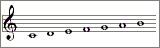
Take the white keys of the piano, C to C. That's C major. Now play those same seven white keys, but start and end on D. Same notes, completely different sound: that's Dorian. Start on E: Phrygian. On F: Lydian. On G: Mixolydian. On A: Aeolian (the natural minor scale). On B: Locrian. They consist of the same tones but the center tone (the tonic) is different.
The C major scale looks like this:
The Dorian church mode contains the same tones but the root tone is D:
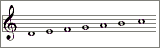
In the same way, the Phrygian church mode has E as root tone. Lydian has the root tone F, Mixolydian has the root tone G, Natural minor (Aeolian) has the root tone A, and Locrian has the root tone B.
Each mode has its own personality, and its own "compare to major" recipe:
- Ionian (= major): bright, resolved, familiar.
- Dorian: minor with a bright 6th. Cool, wistful, jazzy. Think "So What" by Miles Davis.
- Phrygian: minor with a flat 2. Dark, Spanish, brooding.
- Lydian: major with a sharp 4. Dreamy, floating, cinematic.
- Mixolydian: major with a flat 7. Bluesy, rockish, dominant-sounding. Think "Norwegian Wood."
- Aeolian (= natural minor): the classic sad, serious minor sound.
- Locrian: so unstable (flat 5, flat 2) that almost no one writes tunes in it, but knowing it completes the picture.
The single most useful way to hear a mode: don't listen for the notes, listen for where the music comes to rest. Play all the white keys you like, but if your phrases keep landing on D, it's Dorian, not "C major with a D accent."
Beyond the 7-note world
The diatonic family is just the beginning. Some essential others:
- Pentatonic scales: five notes per octave. The major and minor pentatonic are the backbone of blues, rock, and folk, and their no-wrong-notes friendliness makes them every guitarist's first improvisation tool.
- Blues scale: minor pentatonic plus the famous flat 5 "blue note." The basis of blues phrasing and half of rock and jazz vocabulary.
- Whole-tone scale: six notes, all whole steps. Symmetrical, rootless, eerie. Beloved by Debussy and film composers for dream sequences.
- Chromatic scale: all twelve semitones. Not a "key" in itself but the connective tissue between all keys.
And beyond Western music entirely: Arabic maqamat, Indian ragas, and the varied tuning systems of gamelan use microtones and structures that don't map onto our 12-semitone grid at all. The lesson: the 7-note diatonic scale is one solution among many, not a law of nature.
Scale degrees: the names that unlock real understanding
Naming notes by their position in the scale (the 3rd, the 5th, the 7th...) is what lets you talk about music instead of just playing it. Each degree has a name and a function:
- Tonic: home. The center of gravity.
- Supertonic: a step above home, restless, wants to move.
- Mediant: decides whether the scale sounds major or minor.
- Subdominant: comfortably away from home.
- Dominant: maximum tension, the prime mover toward home.
- Submediant: the emotional "other world" of the relative minor.
- Leading tone: one half step below home, pulling upward with all its might.
Once you think in scale degrees, transposition stops being scary: a melody isn't "the notes C-E-G," it's "1-3-5," and it works in every key. This is also the doorway to functional ear training: hearing "that note is the 5th" is a far more durable skill than hearing absolute pitch names.
How to practice scales (without wasting your time)
Most musicians practice scales badly: up, down, up, down, metronome, boredom, no musical benefit. Here's how to make scale practice actually pay off:
1. Say the intervals or degrees out loud as you play. This turns motor memory into ear memory. You're not training your fingers, you're training the connection between your fingers, your ears, and your understanding.
2. Practice in musical shapes, not just runs. Scales in thirds, arpeggios built from the scale, sequences starting from each degree: these are the shapes real melodies use. Straight up-and-down playing barely appears in actual music.
3. Sing what you play. Play a scale on your instrument and sing along, then sing it without the instrument. If you can sing the scale accurately from memory, you truly own it.
4. Improvise with each scale, immediately. After working on a new scale, put on a simple backing track and make music with it for two minutes. This tells your brain what the scale is for, and anchors its sound to a musical context rather than an exercise.
5. One scale per week, in depth. Better to know six scales deeply than thirty superficially. Practice its pattern, its sound, its characteristic chords, and a couple of tunes that use it.
Recognizing scales by ear
Here is the fact that makes ear training for scales surprisingly manageable: a scale is a sequence of small intervals, and to identify a specific scale, you need to know its unique sequence. In practice, for diatonic-based scales, recognition comes down to locating the two half steps in the ladder.
Every major or church-mode scale consists of five whole steps and two half steps. Same seven notes, always. What differs, and what your ear must catch, is where the semitones fall:
- In major (Ionian), the half steps are between the 3rd-4th and 7th-1st degrees.
- In Dorian, they're between the 2nd-3rd and 6th-7th.
- In Aeolian, between the 2nd-3rd and 5th-6th.
So ear training for scales isn't about memorizing 7-note blobs of sound. It's about hearing the two moments where the ladder narrows, and matching their position to a name.
A few practical tips for building this skill:
- Anchor to the tonic. Always identify the home note first, then ask "which degrees are a half step apart?" The tonic is the reference point that makes the half steps meaningful.
- Use reference songs. Just as with intervals, tie each scale to a melody you already know: "Joy to the World" outlines the major scale descending, countless pop choruses live in Aeolian, the Mixolydian sound is stamped into dozens of classic rock riffs.
- Train with feedback, not just with listening. Guessing scales from passive exposure doesn't build the skill; the learning happens in the guess-then-correct loop. Apps like EarMaster are built exactly around that loop: they play a scale, you identify it, you get instant feedback on whether your answer was right, and the adaptive engine keeps drilling the ones you confuse until the sound of each scale becomes automatic. Ten focused minutes a day of that beats an hour of passive playlist listening.
- Then confirm it in real music. Pick songs you love and work out which scale each melody uses. Real melodies jump, repeat, and ornament, so this is harder (and more valuable) than textbook exercises: it's the difference between recognizing scales in a quiz and hearing them in the wild.
The bottom line
A scale is a ladder: an ordered set of tones, defined by its interval pattern, that gives music its tonal identity. The diatonic ladder gives us major, minor, and the modes, which differ only in which rung serves as home. Pentatonic, blues, whole-tone, chromatic, and the world's traditional systems extend the idea in every direction.
Learn the patterns, name the degrees, sing everything, and drill the recognition with instant feedback in EarMaster. Scales stop being homework the day your ear can catch their fingerprints in actual music, and that day comes much sooner with structured practice than with passive exposure.


