
What Is Swing?
The Feel You Can Recognize but Can't Quite Write Down
Play two recordings of the same jazz standard to a beginner, one stiff and mechanical, one played by a seasoned trio, and they'll instantly tell you which one "swings," even if they can't explain why. That unexplainable something is swing: the rhythmic feel at the heart of jazz, and one of the most misunderstood concepts in music education.
Let's fix that. Here's what swing actually is, where it comes from, why it's so hard to notate, and how you can learn to hear it and play it.
The short answer: uneven eighths
Most pop, rock, and classical music you've heard divides the beat into equal halves. Two eighth notes per beat, each one exactly 50% of the beat. Musicians call this playing "straight."
Swing divides the beat into unequal parts: the first eighth note is longer, the second is shorter. Instead of a 50/50 split, you get something closer to a 66/33 split. Or, to put it in counting language, the two notes line up with the first and third notes of an eighth-note triplet.
The most common way to internalize it: count the beat as "1-trip-let, 2-trip-let" and play on 1 and let. That "long-short, long-short" pattern repeated over and over is the rhythmic signature of swing.
But here's the first big misconception to clear up, because it confuses almost everyone:
Swing is a ratio, not a rule
If swing were simply "eighth notes played as triplets," you could write it once in the score and be done. In reality, the exact ratio of long to short varies:
- Fast bebop tempos: the eighths get closer to even, maybe 55/45, because at 300 BPM there's simply no room for a lopsided 2:1 ratio.
- Medium swing: typically close to the classic triplet feel, around 66/33.
- Slow, greasy blues: the long note can stretch much further, sometimes approaching 75/25.
The tempo changes the ratio, and so does the style, the player, and even the moment in the tune. That's why classically trained musicians who "play the triplets" in a jazz band still don't swing: they're executing a fixed ratio instead of negotiating a feel.
A good way to think about it: straight eighths and triplet eighths are the two ends of a spectrum, and every great jazz musician slides along that spectrum, and shades in between, depending on what the music needs.
The other half of the secret: where the weight sits
The uneven division is only half of what makes swing swing. The other half is accent placement.
In most Western music, the strong beats are 1 and 3, and you accent the beginnings of notes. In swing, much of the musical weight sits on the off-beats, beats 2 and 4, and on the second, short eighth note of each swung pair. That little short note leaning against the beat is where the tension lives, and the resolution back to the downbeat is what creates the relentless forward drive that makes listeners tap their feet and dancers hit the floor.
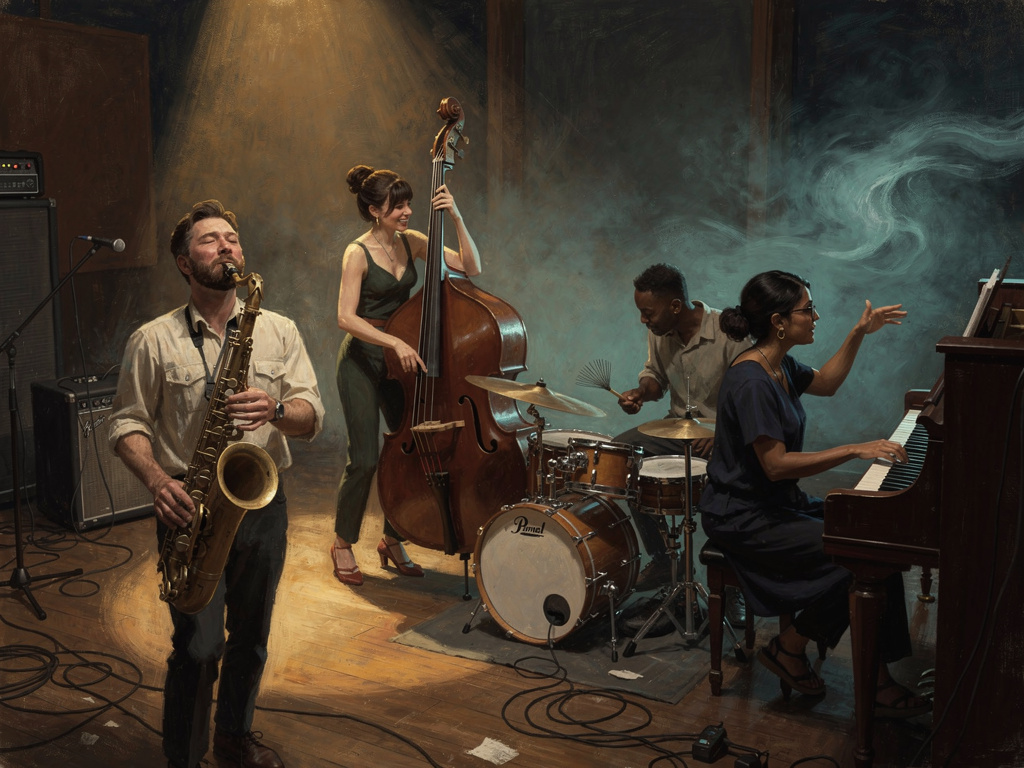
This is also why jazz drummers keep time on the ride cymbal with a swinging pattern, but put their accent on beats 2 and 4 with the hi-hat foot: the opposite of a rock backbeat on 1 and 3. The whole rhythm section works together to create a constant push-pull of tension and release, with the bass walking evenly on all four beats and the comping piano and guitar punching on the off-beats.
The push-pull: laying back and playing on top
Here's a layer that rarely gets taught at all: beyond ratios and accents, swing involves a subtle timing feel between players.
- Playing on top of the beat: slightly ahead, urgent and driving.
- Laying back: slightly behind the beat, relaxed, heavy, cool.
- Locking in: the rhythm section holds the time while soloists lean against it.
The interplay between these placements, say a drummer who sits right on top while a saxophonist lays way back, creates a kind of elastic tension that is the very soul of a swinging band. It can't be notated. It's learned by playing with other people and, above all, by listening.
Why notation fails (and what to do about it)
Because the ratio is flexible and the feel is stylistic, standard notation simply can't capture swing precisely. In practice, composers have three options:
- Write straight eighths and add the word "swing" at the top of the chart. This is the standard convention: the notation is literal, the interpretation is swung. Musicians know to uneven the eighths by feel.
- Write actual triplet figures. Precise, but it clutters the page, and paradoxically makes many players swing too mechanically.
- Write it out exactly as a ratio, for example dotted-eighth plus sixteenth, which equals 75/25. This is the least "swinging" option of all, and most jazz educators advise against treating it literally.
The takeaway: swing is an interpretation, not a notation. If you've ever sight-read a jazz chart and it sounded flat, that's why: the feel was never on the page. It was always in your ears.
Where swing came from
The swing feel didn't appear in a textbook; it was carried across the Atlantic and forged in American dance halls. West African musical traditions brought layered, off-beat rhythms and a flowing sense of time that doesn't sit square on the pulse. In New Orleans, in the blues, ragtime, and march music of the early 20th century, these influences met European harmony and instrumentation.
By the 1930s, the big bands of Duke Ellington, Count Basie, and Benny Goodman turned this rhythmic feel into America's most popular music. Crucially, swing was a dance music first: the Lindy Hop and other dances of the era demanded a groove you could move to, with the emphasis and bounce the dancers needed. The name of the whole era, the Swing Era, says everything: the feel was the product.
Hear it: five essential tracks
The best way to understand swing is to feel it in real recordings. Put these on and listen for the ride cymbal and the long-short eighths:
- Duke Ellington, "Take the A Train" (Billy Strayhorn): the medium-tempo gold standard of a big band swinging.
- Benny Goodman, "Sing, Sing, Sing": relentless, driving, show-stopping swing at its most physical.
- Count Basie, "Jumpin' at the Woodside": the lightest, most effortless swing you'll ever hear. Basie's band made it look easy.
- Glenn Miller, "In the Mood": the famous riff that made swing mainstream pop music.
- Oscar Peterson, "Night Train": swing carried into later decades, hip and heavy at the same time.
Then compare with modern keepers of the flame: Harry Connick Jr., Michael Bublé, or Big Bad Voodoo Daddy. Same feel, new production. For a fascinating contrast, listen to shuffle grooves in blues, or early hip-hop and drum-and-bass: swung divisions show up far beyond jazz, usually under different names.
How to actually learn it
Swing is aural culture, not a theory exercise. You learn it the way you learned your native accent: by immersion and imitation.
1. Listen, and count while you do. Pick one track (Basie is ideal) and follow the ride cymbal. Count "1-trip-let, 2-trip-let" along with it until the long-short shape is burned in. Then stop counting and just feel it.
2. Sing and scat before you play. Sing a simple melody or scat line along with a recording. Your voice is the most honest feedback machine you have: if it swings when you sing it, you're getting it. If it doesn't, no fingering pattern will save you.
3. Tap it with your body. Clap or tap the off-beats (2 and 4) while your foot keeps 1 and 3. Then tap swung eighths against a straight click. The physical coordination is half the skill.
4. Play along with recordings, a lot. Pick up your instrument and play along with the tracks above. Don't read anything; imitate what you hear. Record yourself and compare: does your playing sit in the groove or lean against it?
5. Drill it with instant feedback. This is where an app makes the difference. When you practice swing alone, you can't always tell whether your notes are really landing in the right place. EarMaster's Jazz Workshop includes progressive rhythm-training exercises built around swing patterns, complete with a real jazz drum section, and it listens to you clap or tap your answers in real time, telling you exactly whether you're getting that swing feel right or drifting. That instant, honest feedback loop turns "I think it swings" into "I know it swings," the same way a teacher sitting next to you would, but available every day for ten minutes.
6. Get out and play with people. No app, book, or recording can replace playing in a rhythm section with living, breathing musicians. Sit in at a jam session, join a school jazz band, play with a friend who drums. The negotiation of the beat in real time, someone rushing, someone laying back, you locking in, is where swing goes from an exercise to a language.
The bottom line
Swing is not a dotted rhythm, not a triplet, and not a notation convention. It's a feel: an elastic, tempo-dependent division of the beat, combined with accent weight on the off-beats and a collective sense of where the time sits. It can't be fully written down, which is exactly why it's learned by ear.
So listen deeply, sing it, tap it, drill it with feedback, and then go make it with other people. When a room full of people starts nodding their heads without being told to, you'll know you've got it.


