
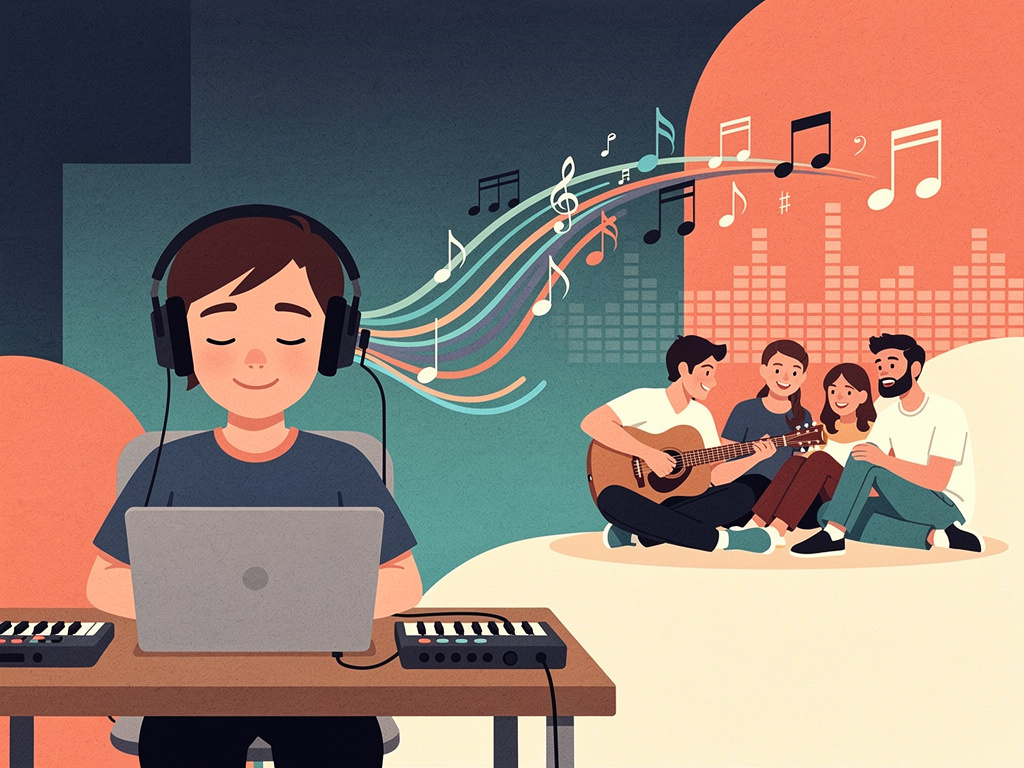
How Does Ear Training Work?
Have you ever watched a musician hear a song once and just... play it? Or pick out the bassline of a track without touching an instrument? It looks like magic, but it isn't. It's the result of ear training: a learnable skill, built one small listening decision at a time.
Let's break down how ear training actually works, why it can feel slow when done on your own, and how training with an app like EarMaster makes the process easier, faster, and far more effective.
What ear training really is
At its core, ear training is the practice of connecting sounds to meaning. When you started learning music, you learned to connect written symbols on a staff to notes on an instrument. Ear training does the same thing, but in the other direction: it teaches you to connect what you hear to what you know.
That means recognizing:
- Intervals — the distance between two notes (a major third sounds "bright," a minor second sounds "tense")
- Chords and their qualities — major, minor, dominant, diminished, and beyond
- Scales and modes — the "flavor" of major, Dorian, Mixolydian, and so on
- Rhythm — durations, subdivisions, and time feels
- Melodies and chord progressions — how notes and chords follow one another
Each of these is a small vocabulary lesson. Learn enough of them, and entire songs start to sound like sentences you can understand, not streams of anonymous sound.
How the brain actually learns it
Here's the thing most beginners miss: your ear doesn't improve through passive exposure. You can listen to music for ten thousand hours and still be unable to identify a perfect fourth. Why? Because the brain only builds these sound-to-meaning connections through active recall with immediate feedback.
The learning loop looks like this:
- You hear a sound.
- You make a guess ("that's a minor sixth... no, a major fifth?").
- You get told whether you were right.
- Your brain updates the mental label for that sound.
Repeat that loop a few thousand times, spread over weeks, and the labels become automatic. This is exactly how you learned to recognize words as a child, and your musical ear learns the same way.
The catch? Doing this loop by yourself is tedious. You'd need a patient friend to play intervals at the piano and grade your answers. Unsurprisingly, most self-taught attempts fizzle out within a week, not because the method fails, but because the logistics fail.
Where an app changes everything
This is where dedicated ear training software earns its keep. An app like EarMaster essentially turns the learning loop into a frictionless daily habit:
It provides the feedback instantly. You hear an interval, you answer, you know immediately if you were right. No guessing at whether you got it correct, no bad habits calcifying because nobody corrected you. That tight feedback loop is precisely what makes the learning stick.
It serves a structured curriculum. EarMaster ships with thousands of lessons arranged in progressive courses, built by music teachers, covering intervals, chords, scales, rhythm, sight-singing, and melody dictation. Instead of wondering what to practice, you just open the next lesson. Structure removes decision fatigue, and decision fatigue is where most training plans die.
It adapts to you. Good apps adjust to your performance: drill the intervals you keep confusing, ease off the ones you've nailed. EarMaster's adaptive questioning engine does exactly this, so you spend your ten minutes a day where they count.
It uses real sounds, not just beeps. Ear training transfers best when you train on timbres you actually encounter: piano, guitar, bass, strings, bands. Training on a variety of sampled real instruments, instead of the synthesised sounds found in almost all other apps, makes your progress easier to translate to real music afterwards.
It engages your whole musical body. This one is underrated: EarMaster lets you sing your answers into a microphone and clap or tap rhythms in real time. Producing the sound yourself, not just pressing multiple-choce buttons, builds a much deeper connection between your ear, your voice, and your sense of time.
It measures your progress. Detailed statistics make improvement visible. Seeing your interval recognition climb from 70% to 90% over a month is genuinely motivating — and it tells you exactly which areas still need work.
It removes every excuse. The app is on your phone, tablet, and computer. Ten minutes on the bus, five minutes before rehearsal. Consistency beats intensity in ear training, and an app makes consistency nearly effortless.
Put together: faster feedback, better structure, smarter difficulty, and easier habits. That's why guided training with an app is dramatically faster and more effective than the DIY alternative: most students reach in a few months what used to take years of unstructured effort.
But the app isn't the finish line
Here's the part seasoned musicians will tell you: ear training only matters if you use it in real music.
An exercise is a gym; music is the sport. Recognizing intervals in a quiz is one skill , instantly hearing the iv chord in the bridge of an actual song, with drums blazing and your band waiting for you to land the next chord, is another. The transfer from "exercise skills" to "musical skills" doesn't happen automatically. You have to practice it deliberately:
- Learn songs by ear. Pick a track you love, put the sheet music away, and work it out note by note. Start simple: nursery-rhyme melodies, then pop hooks, then the bassline, then the chords.
- Transcribe. Even rough transcription, catching the melody and the bass movement of a chorus, forces your ear to work on messy, real material: noisy recordings, fast passages, ambiguous voicings.
- Sing constantly. Sing the melody before you play it. Sing the root of each chord as a progression goes by. If you can sing it, you can hear it.
- Jam and play with others. Nothing trains your ear like live interaction: following a key change someone else made, echoing a riff, hearing your mistake in context and correcting it in real time.
- Dictate what you hear. Hear a jingle on the radio? Try to jot down its melody in your head before it fades. These micro-exercises turn daily life into ear training.
The magic formula is a loop: train in the app, then test in real music, then bring your weaknesses back to the app.The app builds the vocabulary; real music teaches you to speak it.
A realistic weekly routine
- Daily (10 min): guided exercises in EarMaster. Rotate between intervals, chords, rhythm, and sight-singing.
- 2–3 times a week: learn one song by ear, all the way from melody to chords, without tabs or sheet music.
- Weekly: one jam, rehearsal, choir session, or open mic - anywhere you must react to live music.
- Ongoing: keep an eye on your statistics and let them guide which exercises you revisit.
The bottom line
Ear training works the way all skill learning works: active recall, immediate feedback, and consistent repetition. What an app like EarMaster does is remove every practical obstacle between you and that loop — structure, feedback, adaptation, real sounds, and measurable progress — so the process becomes easier, faster, and far more effective.
But the finish line isn't a high quiz score. It's the moment you're in the middle of a song, someone plays something, and you just know what it is — and can answer it on your instrument. Train smart with the app. Then get out there and use those ears where they were meant to be used: in the music.


