

What Are Chord Progressions and Cadences?
If melody is the surface of music, harmony is its architecture. And the two tools that hold that architecture together are the chord progression (how chords follow one another through a piece) and the cadence (how a phrase comes to rest). Understand these two, and you can explain why a chorus lifts, why a hymn settles, and why the end of a thriller scene feels unresolved.
This guide keeps one foot in theory and one in practice: we'll build the concepts properly, then immediately show where they live in real songs and how to use them in your own writing, playing, and listening.
Chord progressions: the harmonic foundation
A chord progression is a series of chords played in a sequence. It is the harmonic foundation of a musical composition and determines the overall tonal character and emotional quality of a piece. Chord progressions are typically built using triads or extended chords and are written using Roman numeral notation to represent the relationship between the chords in a key.
Chord progressions help establish the harmonic structure, tension, and resolution within a piece of music, and they often follow certain patterns or conventions based on the genre or style.
When identifying chords within a progression, the main task is to find their harmonic functions within the key, which means to compare the chord to the tonic of the key. The harmonic functions are written with the Roman numerals I, II, III, IV, etc. Each numeral stands for its corresponding degree within a scale. Therefore, identifying the degree of a chord progression involves your abilities to identify intervals accurately.
All of the seven degrees of the major and minor scales can serve as the root of a triad. The triads on the “tonal” degrees of the scale (I, IV and V) are the most important for establishing the tonality of a piece.
Below is shown the seven degrees of a C major scale:
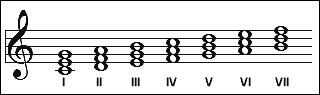
I (C major), II (d minor), III (e minor), IV (F major), V (G major), VI (a minor), VII (b dim)
For example, in the key of C major, a common chord progression is the I-IV-V progression, which consists of the C major (I), F major (IV), and G major (V) chords. Another well-known progression is the I-VI-IV-V, often found in pop and rock music, which in the key of C major would be C major (I), A minor (VI), F major (IV), and G major (V).
Harmonic function: the real theory behind the numerals
Identifying chords within a progression means finding their harmonic function within the key: comparing each chord to the tonic, the home chord. All seven degrees of the major and minor scales can serve as the root of a triad. In C major:
I (C major), ii (D minor), iii (E minor), IV (F major), V (G major), vi (A minor), vii° (B diminished)
The triads on the "tonal" degrees, I, IV, and V, are the most important for establishing tonality, and grouping the chords by function is what turns a list into a theory:
- Tonic function (I, iii, vi): stability, home, rest.
- Subdominant / predominant function (IV, ii): movement away from home, preparation for tension.
- Dominant function (V, vii°): maximum tension, a chord that wants to resolve to the tonic more than anything else in the key.
This gives you the classic harmonic engine of Western music: tonic → subdominant → dominant → tonic. Departure, journey, tension, return. Almost every progression you've ever loved is a walk around this loop, or a deliberate deviation from it.
Note that identifying the degree of a chord in real time depends on interval recognition: you hear a bass note, you relate it to the tonic, you name the chord. That's why ear training for progressions is built on interval skills.
Progressions you should know by name and sound
Some patterns are so productive that they essentially define genres. In C major:
- I-IV-V (C–F–G): the backbone of folk, gospel, blues and a million campfire songs. Full departure-and-return cycle. Try it with a simple strum and you'll hear a complete musical sentence.
- I-V-vi-IV (C–G–Am–F): the famous "four chord" pop progression, the engine behind dozens of Billboard hits. Play it and you'll recognize it instantly: it's the loop underneath a startling share of modern pop.
- I-vi-IV-V (C–Am–F–G): the '50s doo-wop progression, the "Heart and Soul" / "Stand By Me" changes. Instant nostalgia.
- ii-V-I (Dm–G–C): the harmonic sentence of jazz. If you play or improvise jazz, this is your daily bread: learn it in every key, with all its extensions (Dm7–G7–Cmaj7).
- 12-bar blues (I-I-I-I / IV-IV-I-I / V-IV-I-I in its basic form): less a progression than a harmonic institution, the form behind everything from "Hound Dog" to "Pride and Joy."
- vi-IV-I-V (Am–F–C–G): the same four chords as the pop loop, starting on the relative minor. Ballad flavor, wistful without being sad.
Practical exercise: pick one of these, play it in three or four keys this week, and loop it while you improvise a melody on top. This one habit teaches you function better than any diagram: you'll feel the V pulling toward the I, and the ii leaning into the V.
Voice leading: how the pros move between chords
Knowing which chords to play is half the craft; the other half is how you get from one to the next. Voice leading is the art of connecting chords with minimal, purposeful movement, and it's the difference between progressions that sound amateur and ones that sound smooth.
The core principles:
- Keep common tones between chords in the same voice where possible.
- Move the other voices by step, not by jump.
- Avoid parallel motion that blurs the harmony.
A concrete example: going from C (C-E-G) to F (F-A-C), a beginner jumps all fingers down. Instead, hold C, move E up to F, move G up to A. The chord changes completely, but the hand barely moves. Do this across an entire progression and the music starts sounding "connected": that's the sound of hits, session players, and good arrangements.
Cadences: punctuation marks for harmony
If a progression is a sentence, a cadence is the punctuation. It's the melodic and harmonic gesture at the end of a phrase that creates a sense of resolution, conclusion, pause, or deliberate suspense. Cadences shape the structure and flow of a piece: they tell the listener "we've arrived," "breathe here," or "not done yet."
The four main types, in C major:
- Authentic cadence (V → I): the strongest, most conclusive gesture in tonal music, G major to C major. This is the full stop at the end of the sentence. The finality machine of hymns, anthems, and classical endings, and the "button" that pop producers put on the last chord of a chorus.
- Plagal cadence (IV → I): the "Amen" cadence, F major to C major, so named from its role at the end of hymn verses. Softer than the authentic cadence because it skips the dominant's tension: it settles rather than resolves. Ideal when you want warmth instead of triumph.
- Half cadence (anything → V): the phrase stops on the dominant, on the tension chord itself. The musical equivalent of a comma, or of a raised eyebrow: something's coming. Verses and intros often end this way to hand off momentum to the chorus.
- Deceptive (interrupted) cadence (V → vi): the listener expects V to land on I, and it doesn't: it slips to the relative minor instead (G to Am). That "wait, what?" moment is one of the most powerful emotional tools in harmony. Songwriters use it to extend a section that felt like it was ending, and to give a chorus a fresh color on its last line.
A practical way to feel the difference: play a I chord, then a V chord, and stop. Sit in the discomfort of the half cadence. Now resolve to I: that relief is the authentic cadence. Now play V again, but go to vi instead: that surprise, with its touch of melancholy, is the deceptive cadence. Ten seconds of playing, and the theory is in your hands, not just your notes.
Cadences in action: hearing them in real music
Theory becomes useful the moment you can hear it in the wild. Train these associations:
- The plagal cadence is the "Amen" of virtually every hymn ending: sing the last two chords of any traditional hymn and you've played one.
- The half cadence is why the end of many verse lines feels like a question: the melody and harmony pause on V, waiting for the chorus to answer. Listen to almost any verse-chorus pop song and catch the moment the verse "hands off."
- The deceptive cadence is the classic move when a chorus's final line repeats but the chord underneath changes unexpectedly, adding a bittersweet twist. Countless ballads use it on the second-to-last line to delay the final landing.
- Classical music uses cadences architecturally: a sonata's internal half cadences mark where new themes begin, and its final authentic cadence is engineered for maximum arrival, often with the whole orchestra leaning on the V.
How to practice this: from theory to ear to hands
Knowing the names changes nothing until your ears and hands catch up. A progressive routine:
1. Play the vocabulary. Take one key per week. Build all seven diatonic triads, then drill the core progressions (I-IV-V, I-V-vi-IV, ii-V-I) and all four cadences in that key. Use good voice leading from day one.
2. Harmonize melodies you already know. Take "Happy Birthday" or a simple folk tune and put chords under it. You'll discover you already intuit authentic and half cadences: the phrases of the melody tell you where they want to fall. This is songwriting in miniature, and it's free theory practice.
3. Listen analytically, then confirm. Pick songs you love and try to label the cadence at the end of each section. Then check with an instrument. Your guesses will be wrong often at first; that gap between what you thought and what it was is exactly where learning happens.
4. Analyze, then steal. When a song's ending gives you chills, find out which cadence it used, play it in your key, and write something with it. Every professional songwriter is an unashamed borrower of cadence gestures.
5. Train the ear with feedback. Guessing from passive listening plateaus quickly: the skill grows in the guess-then-correct loop. EarMaster lets you train progressions and cadences directly, in the General Workshops, the Jazz Workshops, and Customized Exercises. You hear a progression, you identify its degrees or its cadence type, you get instant feedback, and the app adapts to drill the ones you confuse in real-time until the sounds become automatic labels. Ten minutes a day of this transforms harmony from a page of numerals into something you simply hear, the way you hear words.
6. Write and jam with the vocabulary. Write an eight-bar progression that ends each four-bar phrase with a different cadence: half cadence at bar 4, authentic at bar 8. Then bring it to a jam or a DAW. Real-time application cements the theory permanently.
The bottom line
Chord progressions are the harmonic journeys, and cadences are the punctuation that shapes those journeys into meaning. The functions (tonic, subdominant, dominant) explain why chords pull toward each other; the famous progressions are the well-worn paths through that landscape; the four cadences are the gestures that let you control exactly how strongly you arrive, rest, pause, or surprise.
Learn the numerals, then get them into your ears with structured feedback and into your hands at the keyboard or fretboard. When you can hear a V approaching and feel whether it will resolve, pause, or deceive, you're not just playing music anymore: you're speaking its harmonic language.


